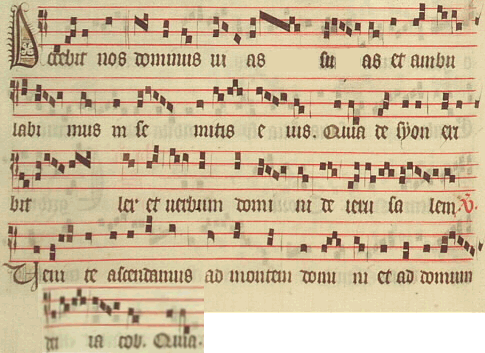
Even Years: St. Bernard, Sermon 5
| Triplicem adventum Domini novimus. Tertius quidam adventus est medius inter illos. Illi enim duo manifesti sunt, sed non iste. In priore quidem in terris visus est cum hominibus conversatus est, quando, sicut ipse testatur, et viderunt, et oderunt. In posteriore vero videbit omnis caro salutare Dei nostri, et videbunt in quem transfixerunt. Medius occultus est, in quo soli eum in seipsis vident electi, et salvae fiunt animae eorum. In primo ergo venit in carne et infirmitate, in hoc medio in spiritu et virtute, in ultimo in gloria et maiestate.
| We have come to know a threefold coming of the Lord. The third coming takes place between the other two. They are clearly manifest but the third is not. In the first coming the Lord was seen on earth and lived among men in the days when, as he himself bears witness, they saw and hated him. In his last coming all flesh shall see the salvation of our God, and they shall look on him whom they have pierced. The other coming is hidden. In it, only the chosen see him within themselves and their souls are saved. In brief, his first coming was in the flesh in weakness, this intermediary coming is in the spirit and in power, the last coming will be in glory and majesty.
| | Adventus siquidem iste medius, via quaedam est per quam a primo veniatur ad ultimum: in primo Christus fuit redemptio nostra, in ultimo apparebit vita nostra, in isto requies est et consolatio nostra.
| This intermediary coming is like a road leading from the first to the last coming. In the first coming Christ was our redemption, in the last he will appear as our life, in this intermediary coming he is our rest and consolation.
| | Sed ne cui forte inventitia vedeantur quae de hoc adventu medio dicimus, ipsum audite: Si quis diligit me, inquit sermones meos servabit, et Pater meus dileget eum, et ad eum veniemus. Legi enim alibi: Qui timet Deum, faciet bona; sed plus aliquid dictum sentio de diligente, quia sermones servabit. Ubi ergo servandi sunt? Haud dubium quin in corde, sicut ait Propheta: In corde meo abscondi eloquia tua, ut non peccem tibi.
| Do not imagine that what we are saying about the intermediary coming is simply our own fabrication. Listen to Christ himself, If a man loves me he will keep my words, and my Father will love him, and we will come to him. I have read elsewhere, The man who fears the Lord will do good, but it is my opinion that more was said of the one who loves, namely that he will keep the words. Where, then, are they to be kept? Without any doubt they are to be kept in the heart, as the prophet says, I have kept your words in my heart, lest I sin against you.
| | Hoc modo custodi verbum Dei: Beati enim qui custodiunt illud. Ergo traiciatur in viscera quaedam animae tuae; transeat in affectiones tuas et in mores tuos. Comede bonum, et delectabitur in crassitudine anima tua. Ne obliviscaris comedere panem tuum, ne exarescat cor tuum, sed adipe et pinguedine repleatur anima tua.
| Keep the word of God in that way for, blessed are they who keep it. Let it pierce deep into your inmost soul and penetrate your feelings and actions. Eat well and your soul will delight and grow. Do not forget to eat your bread or your heart will wither, but let your soul feast richly.
| | Si sic verbum Dei servaveris, haud dubium quin ab eo serveris. Veniet enim ad te Filius cum Patre, veniet Propheta magnus, qui renovabit Ierusalem, et ille nova facit omnia. Hoc enim faciet hic adventus, ut, sicut portavimus imaginem terreni, sic portemus et imaginem caelestis. Sicut fuit vetus Adam effusus per totum hominem, et totum occupavit, ita modo totum obtineat Christus, qui totum creavit, totum redemit, totum et glorificabit.
| If you keep the word of God in this way without a doubt you will be kept by it. The Son with the Father will come to you. The great prophet who will renew Jerusalem will come and he will make everything new. The effect of this coming will be that just as we have borne the image of the earthly man, so shall we bear the image of the heavenly man. Just as the old Adam was poured out throughout the whole man and filled him completely, so now let Christ take possession of the whole man, for he created the whole man, he redeemed the whole man and he will glorify the whole man.
|
Odd Years: Peter de Blois, Sermon 3 on the Coming of the Lord (PL 207, 569-572)
| Tres sunt adventus Domini: primus in carnem secundus ad animam,
tertius ad judicium. Primus in media nocte fuit, secundus in mane, tertius in
meridie. Ut de primo adventu verba veritatis evangelicae prosequamur: Media
nocte clamor factus est: Ecce sponsus venit. Mediam noctem fuisse
intelligo, cum in medio silentio cursum suum nox ageret. Nox apud Judaeos erat,
quorum oculos obscuraverat malitia, ne viderent. Sicut et populus gentium,
ambulabat in tenebris. Venit Sponsus, et factus est clamor.
| The Lord's coming is threefold. He came the first time in the flesh, the second time he comes to the individual soul, a third coming will be at the Last Judgment. The first took place at midnight, the second occurs in the early morning, the third will be at noon. With reference to the first we have the infallible words of the Gospel: A cry went up at midnight, 'the Bridegroom is coming!' From this I note that the first coming was at midnight, the time when, in deep silence, night was pursuing its course. Jew and Greek alike walked in darkness. Then came the bridegroom, and a cry went up.
| | Ruptum est silentium noctis. Venit enim qui illuminat abscondita tenebrarum; abstulit noctem, et fecit diem. Nox, inquit Apostolus, praecessit, dies autem appropinquavit. Et quid est quod media nocte clamor factus est, nisi quod in medio silentio omnium, dum cursum suum nox ageret, atque
omnipotens sermo a regalibus sedibus descendere destinasset, prophetae
cognoscentes adventum Christi, in vocem clamoris et gaudii proruperunt, et
medium silentium ruperunt? Magnus siquidem clamor erat, ubi per se clamabant
prophetae singuli, et insimul universi...
| The silence of the night was shattered. He who lights up the things that are hidden in the dark had come to dispel the night and create the day. The prophets foresaw that the almighty Word was resolved to descend from his royal throne. Realizing that Christ was to come, they broke that profound silence by bursting into shouts of joy. Individually and in chorus the prophets raised their voices, and what a cry that was!
| | Si volumus quod Christi adventus sit nobis ad remedium, praeparemus nos in
ejus adventum. Sicut enim propheta nos in persona Israel docet: Paratus,
inquit, esto, Israel, in occursum Domini, quoniam venit. Et vos,
fratres, estote parati, quia qua hora non putatis Filius hominis veniet.
| The first coming has already passed. For Christ "was seen" among men, and "lived with them" (Bar 3:38). Christ came to fulfil the law for us. This testament, accoring to the Apostle, was consummated in death, for Christ consummated the testament of our redemption on the cross by his voice, his spirit, and his work.
| | Primus adventus jam praeteriit. Christus enim inter homines visus est,
et cum hominibus conversatus est. Christus venit ut legem in se pro nobis
impleret; et quod, juxta Apostolum, testamentum in morte consummatur: ipse
testamentum nostrae redemptionis in cruce voce spiritu et opere consummavit.
| Our experience of the Lord's second coming depends on whether we live in such a way as to make him willing to come to us. If we love him we need have no fear; he will surely come and make his home with us. However, there is always an element of uncertainty about this coming...
| | In secundo adventu sumus, si tamen tales sumus, ut ad nos venire dignetur; securi, quod si eum diligimus, ad nos veniet, ac nobiscum moram faciet. Iste adventus nobis incertus est...
| We are in his second coming, if we are in a condition that he would agree to come to us. We are sure that f we love him, he will come to us and make his dwelling with us. This coming is not certain to us.
| | De tertio adventu certissimum est quod veniet; incertissimum tamen quando veniet. Et quid est certius morte? nil tamen incertius hora mortis. Sapiens dicit: Cum dixerint: Pax et securitas, tunc repentinus superveniet
interitus et dolor, sicut in utero habentis, et non effugient. Nonne illi
homini evangelico adventus Domini terribilis imminebat, cui a Domino dictum
est: Stulte, in hac nocte repetent animam tuam a te: quae praeparasti cujus
erunt? In hac vita de hoc solo securi esse possumus, quod securi non
sumus. Modo sani sumus, modo infirmamur, modo prospera blandiuntur, modo
adversis affligimur, modo sumus, modo non sumus: mors enim nec aetati nec sexui
parcit...
| Concerning the third coming, there is no doubt whatever. The only thing we do not know is when it will be. There is nothing more certain than that we shall die, yet the hour of our death is unknown to us. The wise (Paul) said: It is when people are saying, 'How quiet and peaceful it is' that sudden destruction falls on them, as suddenly as labour pains come on a pregnant woman; and there is no escape (1 Thes 5:3). Wasn't the terrible coming of the Lord about to strike the man in the Gospel to whom the Lord said: "Stupid, this very night they will come for your sould, and all that you have laid away will belong to whom?" Our only security in this life comes from knowing that we are never safe. We vacillate between health and sickness, good fortune and adversity. One minute we are alive, the next we are not. Death spares neither age nor sex.
| | O quam beatus est, qui secure potest dicere: Paratum cor meum, Deus,
paratum cor meum. Et illud: Paratus sum, et non sum conturbatus.
Iste de primo adventu percipit fructum gratiae, de secundo adventu percepturus
fructum salutis et gloriae. Primus enim accessorius est ad secundum. Secundus
praeparatorius ad extremum. Primus adventus fuit occultus et humilis; secundus
est secretus et amabilis; tertius erit manifestus et terribilis. In primo enim
venit ad nos, ut in secundo veniret in nos; in secundo venit in nos, ne in
tertio veniret contra nos. In primo adventu fecit misericordiam; in secundo dat
gatiam; in tertio dabit gloriam, quia gratiam et gloriam dabit Dominus...
| How blessed is he who can confidently say: My heart is ready, O God, my heart is ready! Having gathered the fruit of grace from the Lord's first coming, they will reap a harvest of salvation and glory from the second; for the first opens up the way for the second, and the second prepares us for the third. Lowly and unspectacular in his first coming, secret and gentle in his second, Christ will come openly the third time, and his final coming will fill the world with dread. He came to us at his first coming in order to come into us at the second, and he comes into us at his second coming in order not to have to come against us at the third. At his first coming he showed mercy, in the second he brings grace, at the third he will give glory, for Scripture says: The Lord will confer grace and glory.
| | Reddet enim Dominus sanctis mercedem laborum suorum... De hoc adventu ipse dicit: Ecce venio cito, et merces mea mecum est reddere unicuique secundum opera sua. Ipse non secundum opera nostra mala quae fecimus nos, sed secundum magnam misericordiam suam salvos nos faciat.
| The Lord will give his saints the reward for their labors... Concering this coming, he said: "I am coming quickly, and my reward is with me, to give to each according to his deeds." He will not deal with us according to the evil things we did, but will save us according to his great mercy.
|
| |